
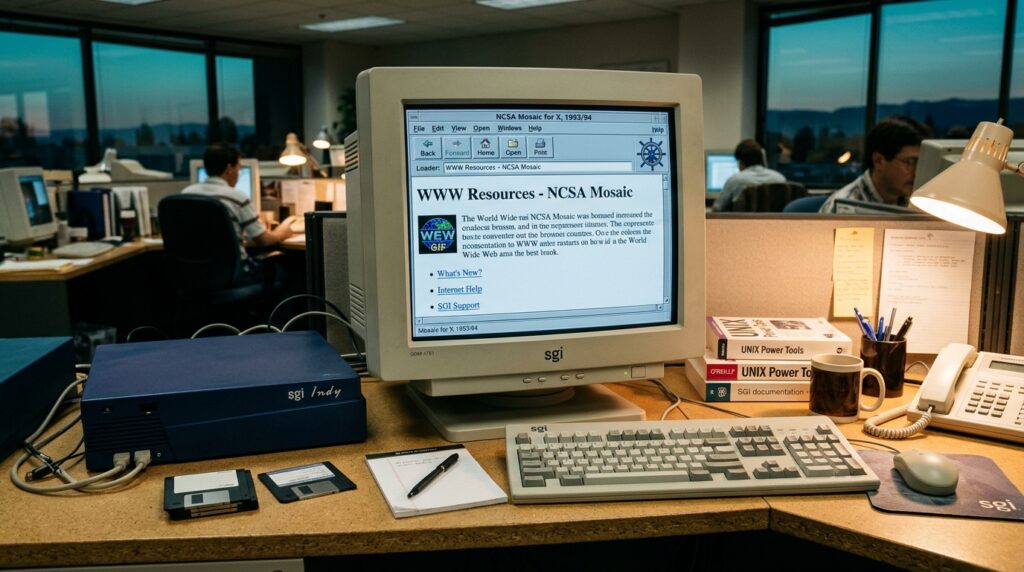
In the humid summer of 1994, the early World Wide Web was suffocating under a quiet, catastrophic design constraint: it had no memory. By original architectural intent, the Hypertext Transfer Protocol (HTTP) was entirely stateless. Every time an early internet user clicked a hyperlink, loaded an inline image, or refreshed a document, the remote server processed the transmission and severed the connection immediately. It treated the client as an utter stranger on every single keystroke.
For high-energy physicists at CERN exchanging academic papers across campus intranets, statelessness was an elegant design choice that kept server architectures lightweight and network transactions simple. But for a brash Silicon Valley startup called Netscape Communications, statelessness was an existential threat. If a web server could not remember who was browsing, how could a customer assemble multiple items inside a digital shopping cart? How could an enterprise service authenticate a subscriber without forcing them to type their username and password on every single page load?
The monumental task of giving the World Wide Web a working memory fell upon the shoulders of a twenty-three-year-old founding engineer at Netscape: Lou Montulli.
Executive Summary: The Invention of the HTTP Cookie
- The Inventor: Lou Montulli, employee number 9 at Netscape Communications, created the protocol in the summer of 1994.
- The Problem Solved: HTTP was entirely stateless, making online shopping carts and persistent user logins technically impossible.
- The Architecture: A tiny client-side text token (maximum 4 kilobytes) stored on the user’s hard drive and transmitted only to the origin domain via the
Set-Cookieheader. - The Unintended Consequence: Advertising networks later hijacked the protocol to engineer cross-site third-party tracking, igniting thirty years of global data privacy regulation.
The MCI Crisis and the Rejection of Server-Side IP Tracking
The catalyst for the invention was not theoretical research; it was a high-stakes commercial contract. Telecommunications giant MCI had formed an alliance with Netscape to build “MarketplaceMCI”—one of the earliest transactional e-commerce shopping portals in human history. MCI envisioned storefronts where consumers could purchase merchandise from companies like Dun & Bradstreet using credit cards over dial-up telephone connections.
However, MCI’s systems architects hit a brick wall. When a shopper selected a shirt on page one, navigating to page two erased their selection. To circumvent this, MCI’s engineers proposed a heavy-handed workaround: track every single user by logging their IP address on central mainframe databases.
Montulli immediately pushed back against this proposal. As an experienced network programmer who had previously written the Lynx text browser at the University of Kansas, Montulli understood that university campuses, corporate offices, and dial-up internet service providers routed thousands of individual workstations through shared gateway proxy servers. If server-side tracking relied on IP addresses, multiple distinct shoppers sitting in the same office building would have their shopping carts and private billing records disastrously commingled into a single session.
Montulli argued that the state should not live on vulnerable corporate mainframes; it belonged securely on the user’s local workstation.
Engineering the 4-Kilobyte Token: Where Did the Name Come From?
Drawing inspiration from Unix systems programming, Montulli adapted the concept of a “magic cookie”—a packet of data that a program receives and sends back unchanged to maintain continuity between subroutines. Working in tandem with fellow Netscape engineer John Giannandrea, Montulli authored the first formal HTTP cookie specification in the autumn of 1994.
The mechanics were deceptively elegant:
- When a user visited a website, the origin server responded with a custom header line:
Set-Cookie: session_id=XYZ123; path=/; domain=example.com. - Netscape Navigator parsed this header and quietly deposited a small text file into a local directory on the client’s operating system (named
cookies.txt). - On every subsequent HTTP request made to that exact same domain, Navigator inspected the directory and attached the stored cookie to the request header.
To verify that the code executed reliably in real-world conditions, Montulli set up a script on Netscape’s internal servers that checked whether an incoming connection had visited the site previously. When Netscape Navigator 0.9 Beta launched in October 1994, it became the first software in history capable of persistent stateful navigation.
Architectural Taxonomy: How Web State Operates
To prevent malicious webmasters from exploiting local storage, Montulli baked strict security parameters into the original engine. The evolution of these parameters formed the architectural foundation of modern web authentication:
| Cookie Classification | Storage & Lifecycle | Primary Architectural Purpose |
|---|---|---|
| Session Cookie | Volatile RAM (Purged on browser close) | Maintains active shopping carts and temporary form inputs across page transitions. |
| Persistent Cookie | Client Hard Disk (Retained until explicit expiry date) | Remembers authenticated login states and customized user preferences across reboots. |
| Third-Party Cookie | Tied to external ad-network domains (e.g., doubleclick.net) | Tracks user behavioral journeys across independent domains to build targeted profiling dossiers. |
Paired with Netscape’s parallel breakthrough in cryptographic tunneling—which we explored in our chronicle of the origins of SSL and TLS—cookies transformed the World Wide Web from an academic noticeboard into an engine of global capitalism.
The Pandora’s Box: How Advertising Syndicates Hijacked State
Montulli had carefully enforced the Same-Origin Policy: a cookie set by merchant.com could never be accessed, modified, or read by competitor.com. In Montulli’s mind, the technology was inherently privacy-preserving because each website operated inside its own isolated digital sandbox.
What Netscape’s engineers failed to foresee was the rise of syndicated third-party asset hosting. In 1995, advertising networks realized that if hundreds of different websites embedded an identical 1×1 transparent tracking pixel or banner image hosted on an external ad server (such as DoubleClick), the ad server could issue its own third-party cookie. As a user browsed from a sports website to a news outlet to a financial forum, that single third-party server could stitch together a comprehensive, timestamped record of the individual’s entire web journey.
In February 1996, the Financial Times broke an explosive front-page story revealing that Netscape Navigator was secretly saving identification tokens on consumers’ personal hard drives. The public reaction was incandescent. Early internet forums accused Netscape of collaborating with intelligence agencies and corporate surveillance monopolies to destroy personal anonymity.
The Battle at the IETF and the Open Standards Defense
Under immense public pressure, Montulli submitted the cookie architecture to the Internet Engineering Task Force (IETF) to establish an open standard. The ensuing debates inside the IETF working groups were among the most venomous in internet history. Academic purists demanded that cookies be outlawed entirely, while commercial enterprises warned that killing cookies would bankrupt the emerging digital economy.
In February 1997, the IETF published RFC 2109. Authored by David Kristol and Lou Montulli, the document officially standardized cookie architecture while strongly urging browser vendors to disable third-party cookies by default. However, as the ferocious browser wars erupted between Netscape and Microsoft’s Internet Explorer—a conflict analyzed in our study on how the browser wars transformed computing—neither company dared to disable third-party cookies, fearing that doing so would break user experiences and drive commercial advertisers to their rival.
The Thirty-Year Echo: From Navigator 1.0 to GDPR
Three decades after Lou Montulli drafted those lines of C code inside Netscape’s Mountain View offices, the humble 4-kilobyte cookie remains at the very epicenter of geopolitical regulatory conflict. From the European Union’s General Data Protection Regulation (GDPR) cookie consent banners to Apple Safari’s Intelligent Tracking Prevention (ITP) and Google’s tortuous attempts to deprecate third-party cookies in Chrome, modern software architecture is still reckoning with Netscape’s original compromise.
As documented throughout our historical analysis of vintage computing privacy lessons, the history of Netscape proves an unyielding technological rule: whenever an engineer invents a mechanism to provide human convenience, commercial incentives will inevitably push that mechanism to the absolute frontier of corporate surveillance.
The spirit of the original Save Netscape petition was fought precisely to preserve this awareness—that the code governing our browsing experiences must remain open, transparent, and accountable to the global user community, rather than locked behind the closed doors of monopolistic gatekeepers.
Frequently Asked Questions About Cookie History (FAQ)
Who invented the first web browser cookie?
The HTTP cookie was invented by Lou Montulli, employee number 9 at Netscape Communications, in the summer of 1994 while developing e-commerce infrastructure for telecommunications company MCI.
Why was it named a ‘cookie’?
Lou Montulli derived the name from the Unix computing concept of a ‘magic cookie’—a programming token passed between software processes that carries state information without modifying the underlying data.
What is the technical size limit of an HTTP cookie?
Under traditional RFC specifications dating back to Netscape Navigator, individual cookies are strictly limited to 4,096 bytes (4 kilobytes), and browsers typically store a maximum of 20 to 50 cookies per individual domain.